[ REHEARSAL NOTES ] DIE FRAU OHNE SCHATTEN
Share
Tuesday 16 June 2026, 8.30 p.m. — Grand Théâtre de Provence — Festival d’Aix-en-Provence
Only his hands can be seen above the orchestra pit: despite his imposing stature, the conductor Klaus Mäkelä is almost invisible to those seated in the auditorium of the Grand Théâtre de Provence, which has been plunged into darkness for several minutes in anticipation of the start of the rehearsal. With a decisive gesture, the passionate Finn launches the opening chord of Strauss’ The Woman without a Shadow. At the piano, Rupert Dussmann then lets rip with the triple opening motif like a thunderclap, sombre and mysterious. But almost immediately, stage director Barrie Kosky, positioned with his entire team in the centre of the auditorium, calls out to Klaus Mäkelä with a touch of humour: the conductor had not waited for the director’s cue, which was intended to allow for a longer, more intense silence before the music began. Klaus Mäkelä’s hands make a brief apologetic gesture, prompting a few laughs, before Barrie Kosky continues speaking. “Applause, applause, applause… silence!” He is envisaging the applause that will greet the beginning of the performances before gradually fading away. A striking silence then ensues, which the opening notes forcefully slice through. With a stage director so thoroughly attuned to the subtleties of opera, the silences form part of the rehearsal process.
This staged piano rehearsal is focusing on the first act of the masterpiece by Richard Strauss and the poet Hugo von Hofmannsthal, the fifth collaboration in their long creative partnership. Illuminated by a powerful shaft of light, the Nurse appears in a striking interplay of light and shadow. Fittingly, the very first word of the opera, which she sings, is Licht - “light”. The role is performed by the legendary dramatic soprano Nina Stemme, who has in the past also sung the role of the Dyer’s Wife in the same opera. The vertiginous depths of Strauss’ orchestration are reduced here to a single piano part, which nevertheless miraculously succeeds in preserving the density of the writing and, within a matter of seconds, completely captures the listener’s attention.
In the absence of the singer performing the Messenger, with whom the Nurse is normally meant to converse in the opening scene, it is Volker Krafft, the assistant conductor, who sings his lines. Seated in the front row at the edge of the pit, he follows the score on a discreetly backlit music stand, allowing him to keep an eye on both the stage and the conductor. Without any preparation, he is able to sing any role when required, even though he naturally lacks the vocal projection of an operatic voice capable of carrying over an orchestra. The contrast is striking when members of the stage crew intervene through a microphone and Nina Stemme replies with at least the same volume, but without one. Conversely, during the rehearsal, the volume of the piano in the stage monitors has to be increased so that the performers can hear the accompaniment on stage: buried in the orchestra pit, the piano would be inaudible without amplification. The challenge will be quite different when the hundred or so musicians of the Orchestre de Paris take up their places in the theatre.
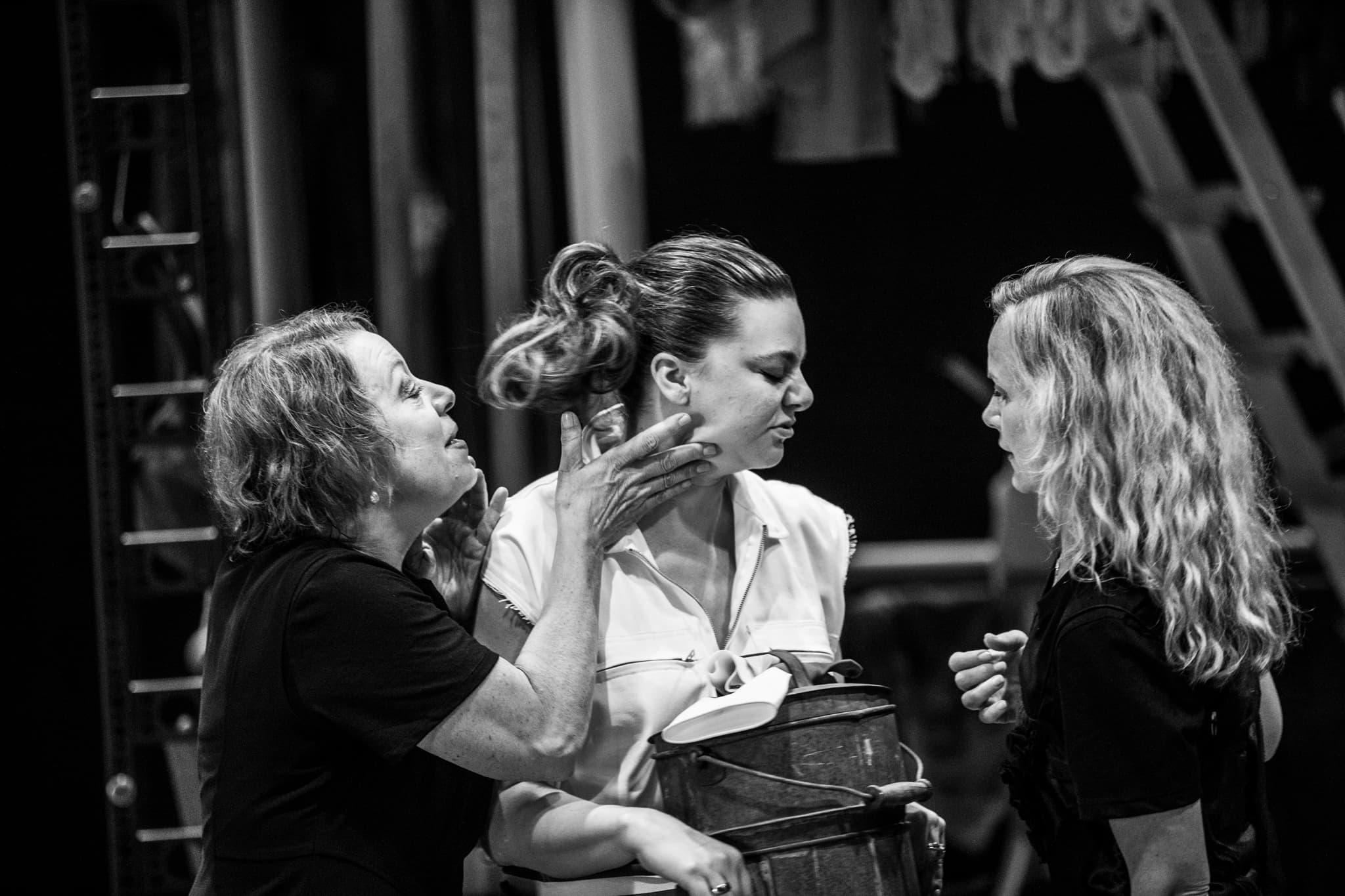
The first act pursues its course. When Vida Miknevičiūtė, the outstanding singer of the monumental role of the Empress, makes her entrance on stage, Barrie Kosky immediately notices that something is amiss: the wig intended for the singer is not up to expectations as it covers too much of her forehead. The stage director therefore calls over the members of the wig department to request adjustments and to explain the effect he has in mind. In the meantime, he asks Nina Stemme to help make her stage partner’s forehead a little more visible. The movements of the dancers surrounding the Nurse require several adjustments. After a moment’s reflection, Barrie Kosky suggests a subtle change: instead of being joined by the dancers downstage, the Nurse will remain apart while the dancers gather together facing the audience. Then, in a highly theatrical gesture, she will simply have to split up the small group they form, thus reinforcing the magnetic presence of her complex character.
Changes are not uncommon at the crucial stage when rehearsals move into the theatre where the performances will take place. After several weeks in the rehearsal studio, it is time to take the full measure of the space and of the effects as they are perceived from the auditorium. Barrie Kosky can therefore be seen stepping onto the stage to demonstrate to a singer a movement that had just occurred to him, a repositioning that would better suit the lighting, or a new arrangement of certain elements of the set, which the stage management teams are quick to photograph to keep a record. While some elements can still be modified, others must correspond exactly to what has already been established. Thus, when it becomes apparent that a bucket, which the Dyer’s Wife, sung by Ambur Braid, is supposed to lift and hand to the Empress has not been placed in the correct position, the props team must be called onto the stage to rectify the oversight. The slightest hitch in the setting of the scenery can jeopardise an entire sequence of stage action.
At this fascinating stage of the process, the images that appear on stage are the tangible, sometimes prodigious, embodiment of ideas that first emerged several months earlier in the minds of the creative team. The performers therefore respond with great flexibility to the instructions they are given in order to move closer to the original vision. Thus, Tomasz Kumięga, who plays the One-Eyed Man, one of Barak the Dyer’s brothers, is asked to let out a more heart-rending cry when he is attacked by his brother, the One-Armed Man, sung by Daniel Miroslaw. It is within this fascinating space of negotiation between ideal and reality, conception and rehearsal, that the excitement of opera as a total work of art truly resides.
Guillaume Picard
English translation by Christopher Bayton
La Femme sans ombre - Festival d'Aix-en-Provence 2026 © Jean-Louis Fernandez
